
How Toyota turned stopping work into a competitive advantage
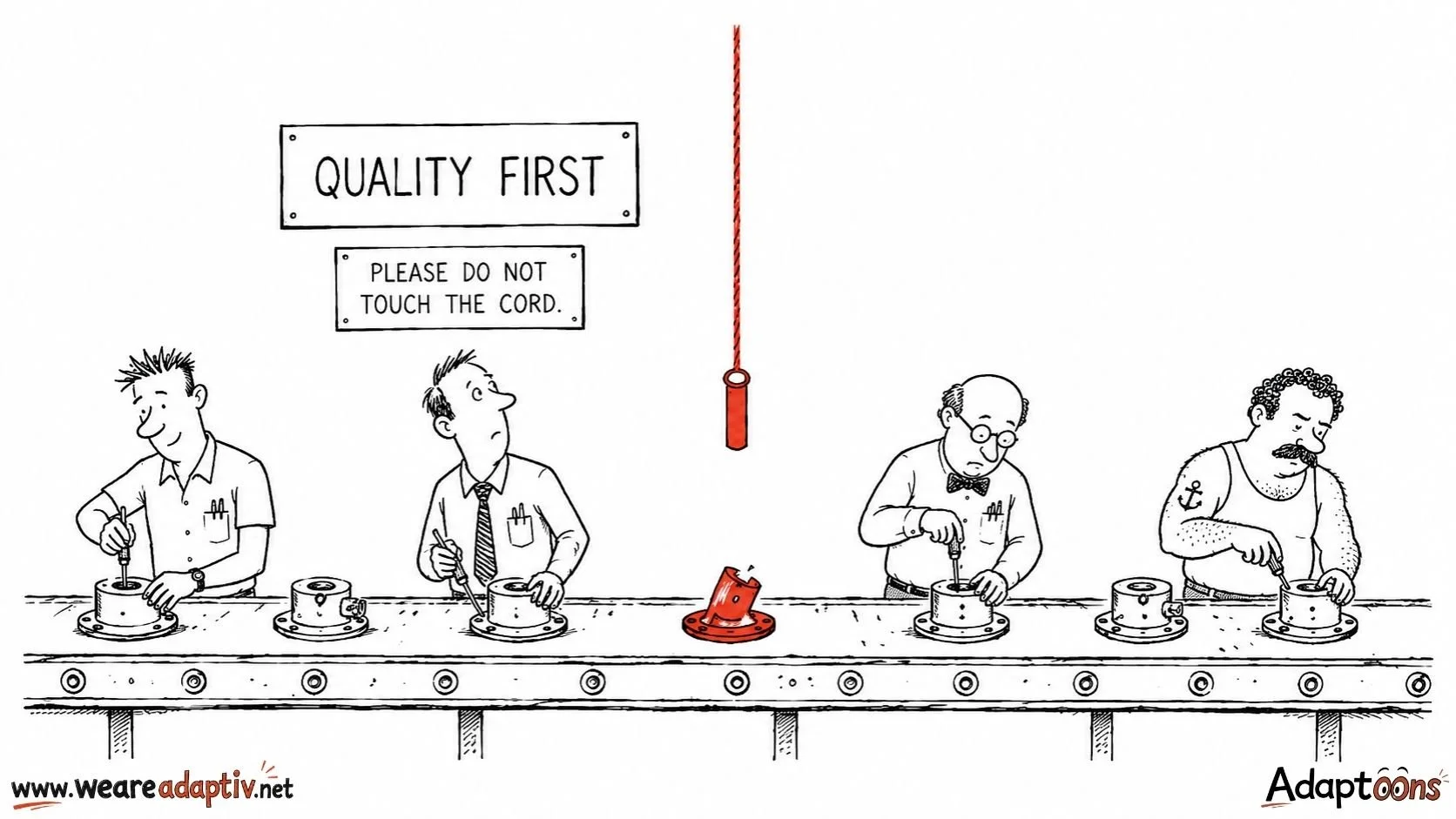
Rick Madrid spent seventeen years building Chevrolet trucks at General Motors' plant in Fremont, California. It was among the worst factories in the company. When it closed in 1982 there were more than seven hundred grievances outstanding and absenteeism was running at roughly a quarter of the workforce, according to Paul Adler's study of the plant at the University of Southern California. Madrid drank on shift. He was ashamed enough of what he built that he did not like telling people where he worked. Then the plant reopened in 1984 as a joint venture with Toyota, most of the same people came back through the same union, and Madrid was among those sent to Japan to see how the work was done there. He watched a group of workers stop an entire assembly line to deal with one bolt that had gone in wrong. He described the moment years later, on the radio programme This American Life. “One bolt. One bolt changed my attitude.”
Toyota sold a record 11.3 million vehicles in 2025 and held its place as the world's largest carmaker for the sixth year running, ahead of Volkswagen's just under nine million. Consumer Reports put it top of the 2026 brand reliability rankings, ahead of Subaru and of Toyota's own Lexus. The production system behind those numbers has been public property for decades, taught in business schools and demonstrated to any manager who books a plant tour.
Which raises a question that ought to bother anyone running a company. If the method has been open for forty years, why have so few businesses reproduced the result?
Part of the answer hangs above the line at every Toyota plant. Any person on the floor who sees a fault, a shortage, a tool problem or anything they merely suspect is wrong can pull what’s known as ‘the andon cord’.
The cord is not a kill switch. Pull it and a light comes on above your station, music plays, and the line keeps moving. What you have bought is a window of about five to thirty seconds before the car reaches the fixed stopping point at the end of your work zone. In that window a team leader arrives. If the two of you sort it out, the leader pulls the cord again and the line never stops at all. If you do not, it stops, and your problem becomes everybody's problem.
That window is the whole design, and it only works if there’s someone available to run over and help. So Toyota staffs for it. Jeffrey Liker, who has studied the company for decades, describes the standard arrangement as a group leader, four team leaders and twenty to twenty-five people, with two of the four team leaders working the line at any given moment and the other two off it, rotating, waiting to answer a call. A serious slice of the wage bill goes to people whose job description includes being interruptible.
The cord costs almost nothing. The person who comes running is the visible cost; the deeper investment is the system that makes their arrival useful.
Toyota pays for spare leadership capacity, stable processes, rapid problem-solving and the accumulated trust that raising a fault will bring help rather than blame.
Toyota built an organisation in which interruption counts as productive work. Most businesses copy the permission to raise a problem while removing the capacity required to respond to one. They ask people to speak up, staff every leader to full utilisation, reward uninterrupted output and treat delay as failure. The signal remains. The institution behind it disappears.
The idea is older than the car company. Sakichi Toyoda's power loom, completed in 1897, stopped itself the moment a thread broke, so that no defective cloth was woven past the fault and one operator could attend to many machines. His son Kiichiro developed the just-in-time idea in the late 1930s and introduced it at Toyota’s Koromo plant in 1938. Taiichi Ohno spent the post-war decades turning both ideas into a working system. Toyota did not overtake General Motors in annual production until the middle of the 2000s. That is a century between the root idea and the visible result.
That century of accumulated practice is the moat. Anyone can hang a cord, and many companies have. Building what sits behind it takes far longer than a planning cycle, and it shows up as a cost centre long before it shows up as margin: trained leaders, a process stable enough that the calls stay manageable, and years of accumulated evidence that pulling the cord will not cost you your job. Fujio Cho understood the risk when Toyota was globalising. In April 2001 he put his name to a thirteen-page booklet setting out the Toyota Way on two pillars, continuous improvement and respect for people. According to the Toyota veteran Isao Yoshino, Cho's particular worry was that overseas plants would take the tools and leave the second pillar behind.
Toyota is not immune to any of this, and it would be dishonest to write as though it were. In July 2024 Japan's transport ministry issued a correction order against the company over improper data used in vehicle certification testing, criticising management involvement and record keeping. That failure happened in the offices, away from the assembly line, in the part of the business where nobody had a cord to pull. What matters for our purposes is the remedy. Among the measures Toyota filed with the ministry, and was still reporting on quarterly more than a year later, was a rewrite of certification procedure so that work can be halted when an abnormality is found. Faced with a failure of its own system, the company installed the missing stop.
The sharpest evidence of what that mechanism is worth comes from a company that removed one. After Boeing merged with McDonnell Douglas in 1997, Harry Stonecipher told the Chicago Tribune that the culture change was deliberate, so that the company would be “run like a business rather than a great engineering firm”. In 2001 Boeing moved its headquarters out of Seattle, its home since 1916, to Chicago, on the stated logic that head office should sit apart from operations. By June 2018 Ed Pierson, a senior manager at the 737 factory in Renton, was emailing the programme's general manager to say his internal warning bells were going off, and recommending that the line be shut down until the backlog was under control. He was told, in substance, that the military could afford to stop and a profit-making business could not. He escalated it to the chief executive and then to the board. Two crashes killed 346 people. Five years and two chief executives later, the National Transportation Safety Board found that a door plug had left the side of an Alaska Airlines 737 in flight because four bolts were never reinstalled, and put the probable cause on Boeing's failure to train, guide and oversee the people doing the work. Investigators recorded factory workers describing pressure to go faster and to perform tasks they were not qualified for.
In plain money the difference is visible on both sides, and neither side is simple. Toyota reported record revenue of ¥50.7 trillion for the year to March 2026, with operating profit down 21.5 per cent on the year before, mostly on tariffs. A healthy root system does not exempt anyone from the weather. What it protects is the part that compounds: warranty and repair costs, and the price a customer will pay without arguing. Boeing lost roughly $36 billion between 2019 and 2024. It returned to an annual profit in 2025, though the $2.2 billion arrived alongside a $9.6 billion gain on the sale of part of its digital business, while the commercial aeroplane division lost around $7 billion. Its output was capped by a regulator for two years, and the Federal Aviation Administration has only just returned the authority to issue airworthiness certificates on its own aircraft. For the investors and acquirers among you, that regulatory sequence is the number that matters at diligence, because it prices in years, not quarters. The lost decade was not caused by a door plug. The door plug was the receipt.
None of this requires a factory or a fortune. Pick one decision in your business where a bad outcome is expensive and where the person closest to the work sees it first. A shipment that should not go out. A release that should not ship. A job that should not be signed off. Give one named group the standing right to halt it. Then write down what happens next, because the right on its own is worthless. Name who comes, and how long they have to get there. Name what happens if it cannot be resolved inside that window.
Then fund the answer. Somebody has to have enough slack in their week to drop what they are doing and arrive, which a spreadsheet will read as waste. Slack without skill becomes delay, and authority without a response system becomes theatre. Toyota combined spare capacity with a precise protocol for what happens after the signal. For the owners and founders reading this, that is the real cost of the whole idea, and it is the line item that goes first in a tight quarter. Run it for a year and track four things together: how often it is used, how quickly help arrives, how many problems are contained before escape, and how often the same problem recurs. A rising pull rate can signal healthier candour. A falling rate can signal better work or growing fear. The surrounding evidence tells you which.
Most businesses would say their people are encouraged to raise concerns. Encouragement is cheap, and it is not the test. The test is what happens when your newest and most junior employee decides something is wrong and pulls on whatever you have given them. Does anything actually stop? And when it stops, do people move towards the problem, or towards the person who raised it? If the honest answer is that nothing would stop, then what you have is a suggestion box and a poster.