

What goodwill was always pointing at.

Finance has understood for more than two centuries that a business is worth more than its accounts can explain.
It has called the missing value goodwill, human relations, future cashflows, intangibles and ESG. Each idea revealed something important, yet stopped short of directly asking, what are the organisational conditions that determine how effectively opportunity becomes economic output, and how long that output can be sustained?
Meridian begins with that unfinished question.

The tree describes a question finance has been asking for centuries.

At Adaptiv, we see every business and organisation as a living system. We use the tree as a metaphor for how living systems create and deliver value, and Meridian analyses companies through this lens.
The roots hold the organisational health from which future capability grows.
The trunk carries that potential through the friction the business has accumulated.
The canopy is where work gets done, and results eventually become visible.
The fruit is the surplus available for distribution and renewal.
The analogy is simple, but the economic question beneath it is significant.
What determines whether a business can continue converting opportunity into sustained value?
Long before modern management theory, goodwill was already pointing towards an answer.
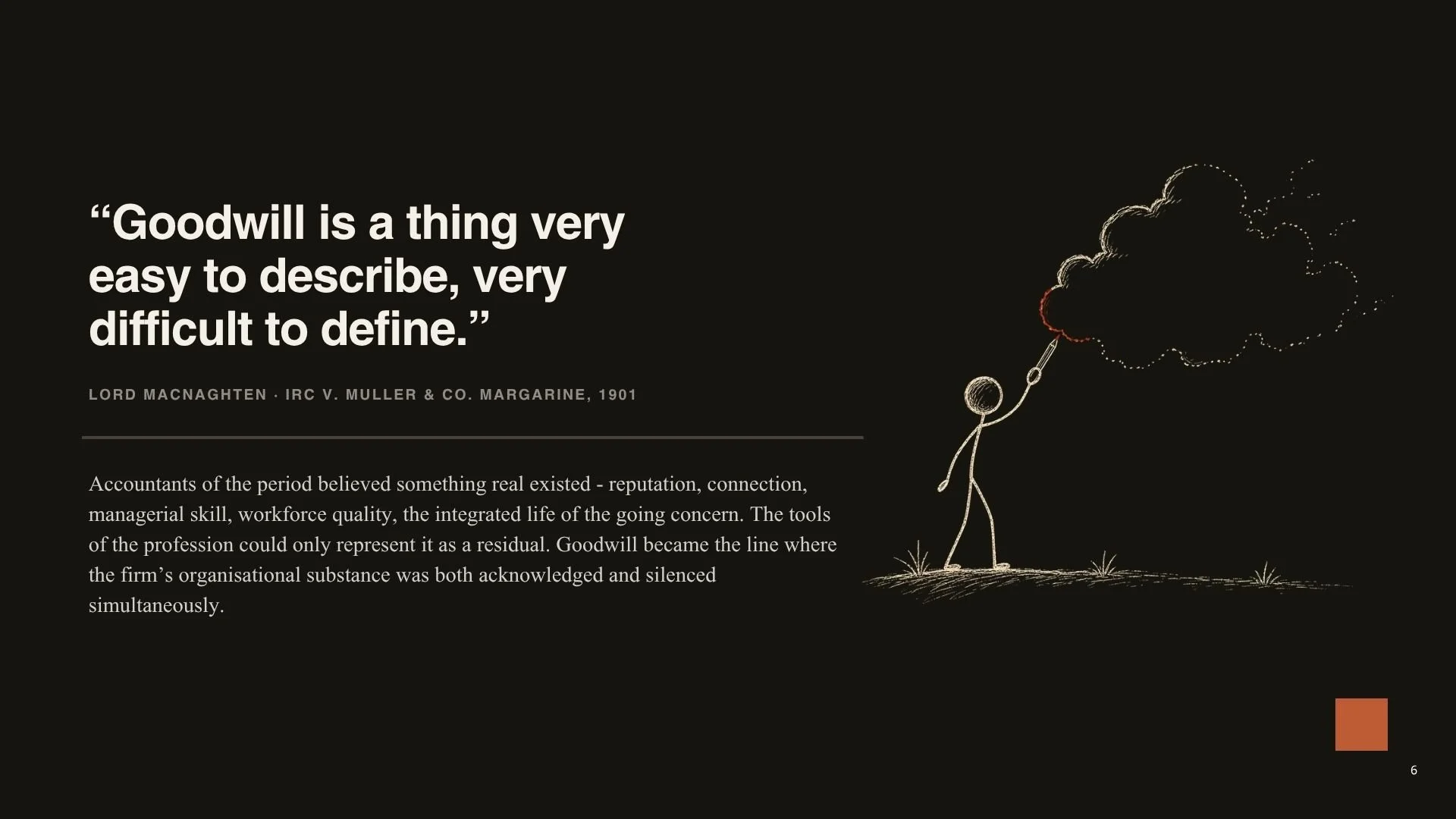
“Goodwill is the sap and life of the business,
without which the business would yield little or no fruit.”
Lord Macnaghten · Trego v Hunt, 1896

In fifty years, the foundation of corporate value has flipped.
In 1975, tangible assets represented the majority of S&P 500 market capitalisation. By 2025, Ocean Tomo’s residual method placed the intangible share at 92%.
Source: Ocean Tomo, Intangible Asset Market Value Study, 2025. The study derives intangible value as a residual: market capitalisation less net tangible assets. This means the figure also absorbs market sentiment and accounting conservatism, and should be read as directional rather than precise. Investment-based measures (Corrado, Hulten and Sichel) are more conservative but confirm the same trajectory: intangibles are now the dominant and fastest-growing category of corporate investment. Brand Finance puts undisclosed global intangible value at USD 79 trillion in 2024, approaching USD 98 trillion by 2025, with roughly 80 percent of it off balance sheets.

One question, pursued through five successive lenses.

Each era below moved closer to the organisational substance behind enterprise value, and while each made genuine advances, they all encountered a boundary they couldn’t cross.
1810
Goodwill
Named it as a residual. Real, saleable, unfindable in the ledger.
1924
Human Relations
Named it as a social system. Measured the substance, not the value.

1938
Discounted Cashflow (DCF)
Encoded it invisibly as g . Rigorous, and silent on origin.

1988
Intangibles
Named it as intellectual capital. Reporting moved; valuation didn’t.

2004
ESG
Named it as governance and stakeholder factors.

Next
Organisational Health
Examines how organisational health converts opportunity into sustained economic output.


Goodwill recognised that something real existed beyond the ledger.
Established businesses could attract future custom because of reputation, trust, relationships and what they had built over time. Goodwill acknowledged the economic effect. It recorded the difference between identifiable assets and the value attributed to the whole business. It did not identify or measure the organisational system producing that difference.

Human relations located part of the value in the social system.

The human relations movement showed that output depended on relationships, group norms, managerial assumptions, trust and the quality of cooperation, as well as physical conditions and financial incentives. It began to describe the substance goodwill had gestured towards. It struggled to translate that substance into a credible, auditable economic measure.

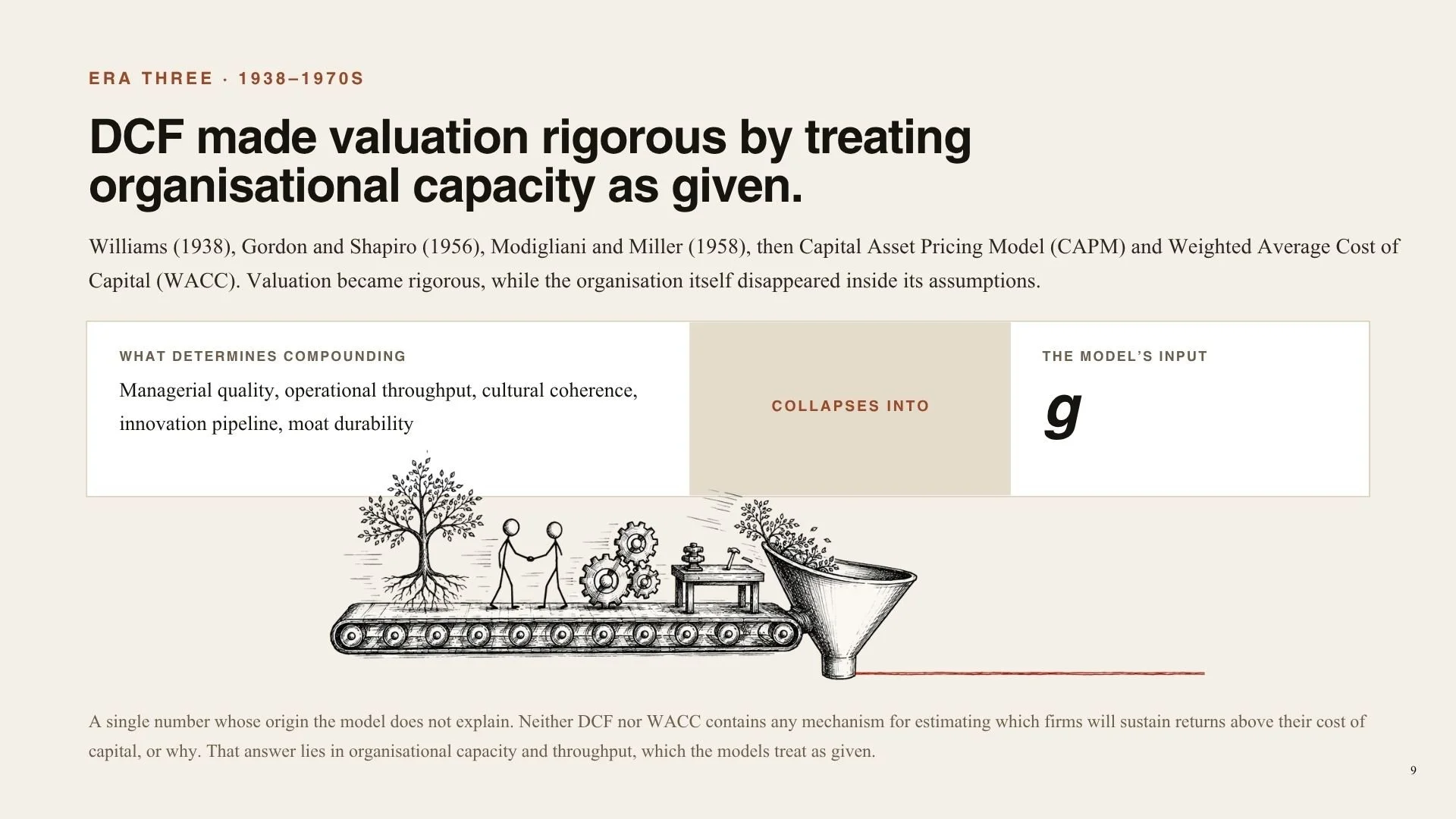
DCF forecast future cashflows while treating an organisation’s capacity to deliver them as a given.

Discounted cashflow brought rigour to valuation by making future cashflows central. Yet its perpetuity assumptions say little about the organisational conditions needed to deliver those cashflows. Leadership quality, cultural coherence, adaptive capacity and the ability to renew competitive advantage are compressed into assumptions the model itself cannot explain.

Intangibles gave more of the missing value a name.

Brands, intellectual property, customer relationships, knowledge and organisational capital entered mainstream debate. Reporting advanced. The central difficulty remained: an asset can be valued at a moment in time, while its future value depends on the health of the organisation responsible for renewing, protecting and deploying it.

ESG widened the field but remained distant from organisational causation.

ESG brought governance, human capital and stakeholder concerns closer to investment analysis. Its ratings largely measure policies, disclosures, exposures and controversies. They offer useful signals, while disagreement between rating systems and the distance between disclosure and lived organisational reality, limit their ability to function as a direct measure of future institutional capacity.
Goodwill named the residual.
Human relations described the social system.
DCF priced future cashflows and impact.
Intangibles named more of its assets.
ESG widened the field of view.
What organisational conditions determine whether a business can keep turning opportunity into value?

Organisational reality can move years before the accounts do.

Financial results are visible at the end of the causal chain.
A business can continue reporting revenue, margin and market strength while trust erodes, learning slows down, experienced people leave, decisions become harder and yesterday’s successful assumptions become tomorrow’s constraints.
During that interval, the valuation still reflects a capacity that might be slowly leaking away.
The point is not that every failure has one cultural cause. It is that conventional valuation has no direct instrument for testing whether the organisation’s capacity to deliver on its future value creation promises is intact.

In every case the organisational reality was visible for years before the market registered it.
General Electric
USD 600bn of market capitalisation in 2000 to under USD 60bn by 2018; removed from the Dow after a century. GE Capital reached 55 percent of profits by 2007, and an earnings-management culture had become the operating logic of the firm.
Wells Fargo
A USD 185m fine, an asset cap in force until February 2025, and an estimated USD 220bn of foregone market value. The bank’s own report found the board had been aware of sales-practice issues as far back as 2002 - fourteen unpriced years.
Boeing
No annual profit since 2018; cumulative losses over USD 30bn by mid-2024; USD 12.7bn erased in a single session in January 2024. The 1997 merger replaced an engineering culture with a financial one - twenty-seven years before the full financial consequences became visible.
Kraft Heinz
A USD 15.4bn goodwill impairment in one day, February 2019. R&D had been held at 0.36 percent of sales against Unilever’s 1.68. The accounting registered the depletion only when the impairment test forced the admission.

Seeing the missing layer requires more than a culture survey.
A genuine organisational measure would need to satisfy five requirements simultaneously. Together they set a much higher bar than correlation, disclosed policy or self-reported sentiment alone.
1 - Leading
Connect organisational conditions to future cashflow before the effect is fully visible in financial performance.
2 - Consistent
Produce broadly comparable findings when used by different qualified assessors.
3 - Independent
Remain distinct from the organisation’s own description of itself.
4 - Auditable
Rest on evidence that can be checked rather than sentiment alone.
5 - Structural
Reach knowledge, trust, decision-making, information flow and the deeper architecture of value.

Meridian adds the organisational evidence the earlier lenses approached.

Meridian does not replace financial accounts, discounted cashflow, goodwill accounting, intangible analysis or ESG.
It adds a direct reading of the organisational conditions beneath them.
The accounts show what the business has produced. Meridian helps reveal what its current conditions may allow it to sustain next.
Download the 19-page visual research summary, What goodwill was always pointing at: The hidden organisational conditions behind enterprise value.
It traces the progression from goodwill and human relations through DCF, intangibles and ESG, then shows where Meridian takes the argument next.

Take the argument with you.
The inversion from tangible to intangible corporate value
The five historical lenses
The organisational assumption inside valuation
Four cases of delayed financial recognition
Five criteria for a credible measure
The connection to the Meridian Framework