
Cadbury’s takeover began before Kraft arrived
Cadbury wasn’t sold because it was failing.
On 19 January 2010, one week after reporting performance ahead of market expectations, its board recommended Kraft’s final offer. Revenue was growing. Margins had improved. The business had just made the strongest possible argument for its own future and received an offer valuing it at 13 times underlying 2009 EBITDA.
Cadbury could still say no. It no longer had anyone with enough power to make no a final answer.
The headline figure was 850 pence a share. Ten pence of that was a special dividend, drawn from the final dividend of 12.3 pence Cadbury had already announced and which would otherwise not have become payable once the offer went unconditional. Shareholders were handed back part of a distribution already sitting inside the company, and it was counted as part of the price. On the same day Cadbury agreed to pay Kraft an inducement fee of £117.7 million, roughly one per cent of the offer, if a rival bidder succeeded. Both arrangements were lawful, conventional and negotiated by capable people on both sides.
By every conventional measure the recommendation was defensible. Kraft offered 500 pence in cash and 0.1874 Kraft shares for each Cadbury share, valuing the ordinary share at 840 pence and the company at £11.9 billion. Cadbury’s board, advised by Goldman Sachs International, Morgan Stanley and UBS Investment Bank, unanimously recommended acceptance. Roger Carr, its chairman, said the offer represented good value and welcomed Kraft’s commitments to Cadbury’s heritage, values and people. The all-in figure was close to fifty per cent above the price before Kraft’s interest became public.
The praise wasn’t foolish. The company beneath the negotiations was performing.
The defence of the company didn’t collapse that morning. It was dismantled in respectable increments, through decisions that looked like focus, efficiency and value release at the time they were made.
That’s why Cadbury is worth the space. The condition that left it exposed is the same condition that reads as health in a set of accounts: a focused company, a clean structure, a liquid register, one class of shares, and nobody awkward holding enough votes to block a transaction. From inside the business that looks investable. From the other side it looks available.
From inside the business that looks investable. From the other side it looks available.
The vulnerability was older than Kraft’s bid, and the decision that made it easier to exploit can be dated.
On 15 March 2007 Cadbury Schweppes announced that it would separate its confectionery business from its Americas beverages operation. At almost the same moment Nelson Peltz’s Trian Fund Management disclosed a stake of just under three per cent. The holding later increased and the pressure to break up the group was public. The separation completed on 7 May 2008, when Dr Pepper Snapple Group began trading independently.
Cadbury’s ownership was already dispersed. What the demerger removed was one of the obstacles standing between that ownership and a buyer. What remained was a focused global confectioner with one class of shares, one vote per share, no controlling family holding, no anchor trust and no equivalent of the American poison pill.
Under the takeover rules then in force, Cadbury’s board could argue for independence, negotiate, seek another bidder and recommend rejection. What it could not do was make the company unavailable. Frustrating action required shareholder approval. Once Kraft had financing and enough shareholders preferred the offer, the board had no constitutional defence of its own left.
Keeping the combined group was a different choice. It would have made Cadbury larger and more complicated and less immediately attractive to a confectionery buyer, because an acquirer would have had to take on two businesses rather than one. It might have deterred Kraft or raised the price of entry. It would not, by itself, have created a lawful power to refuse.
Complexity is a hurdle. Control is a defence.
The cost of keeping that hurdle was real. Cadbury would have had to forgo the value release activist holders were demanding, retain a structure investors increasingly regarded as unfocused, and absorb the criticism in public. No board paper would have described that as paying for future independence. It would have appeared as a failure to simplify.
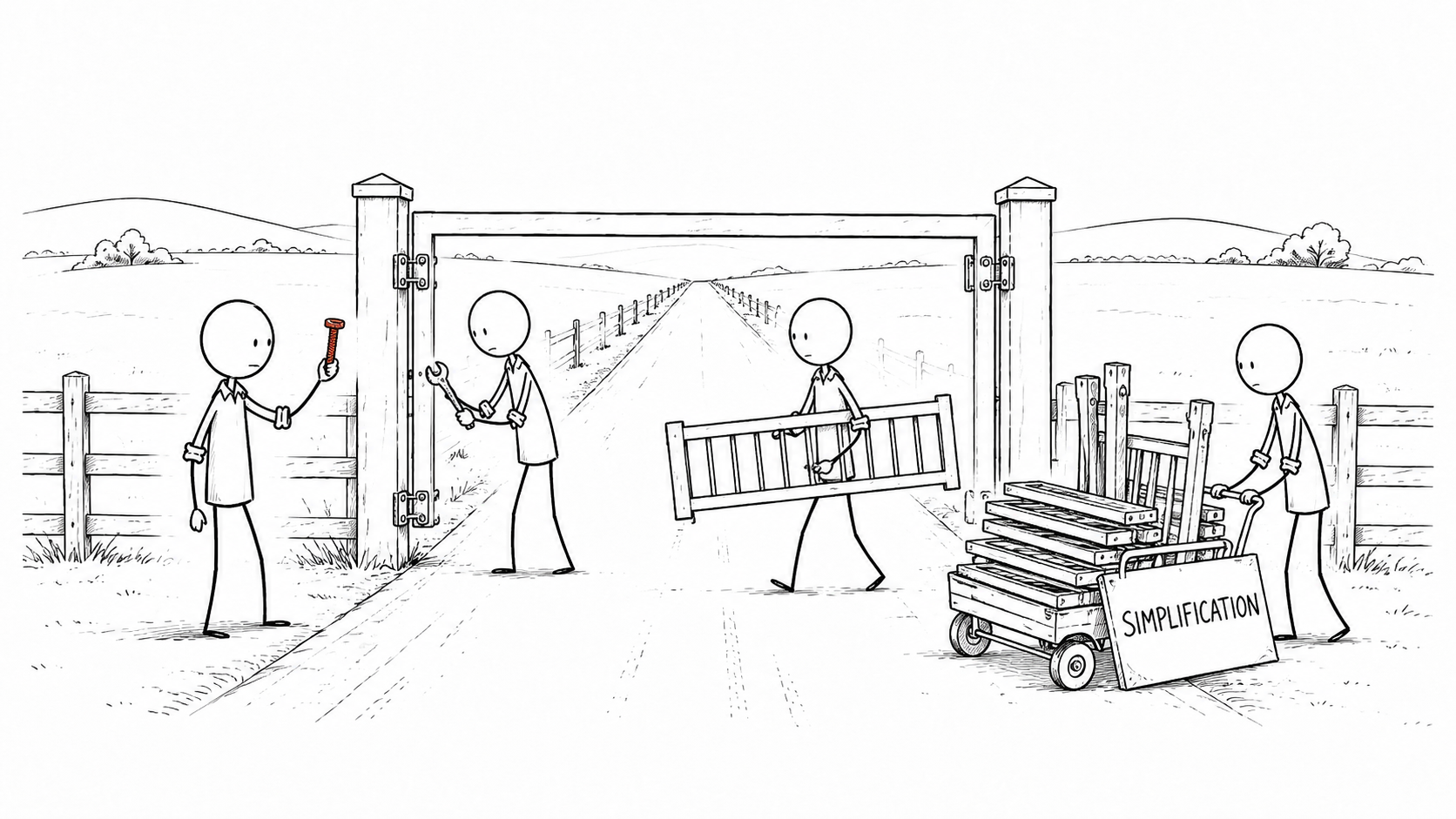
That is how structural defences disappear. They are rarely removed under a heading marked defence. They are dismantled as inefficiency.
Anybody who has taken a wall out of a building knows the feeling. It was in the way, it was doing nothing you could see, and the room is better without it. You find out what it was carrying on the day something moves.
Between the demerger and the recommended offer, nothing in Cadbury’s financial record announced a crisis. Revenue grew, margins improved, and the 2009 numbers beat expectations. What changed during the offer period was the economic question attached to a growing proportion of its shares.
Merger-arbitrage funds bought from longer-term institutions as Kraft’s bid progressed. The departing holder had been deciding whether Cadbury’s future as an independent company was worth more than the offer. The arriving holder was deciding whether the gap between the market price and Kraft’s offer would close. By the time the board agreed to recommend the transaction, more than thirty per cent of the company was reportedly held by hedge funds.
Those funds did not create Cadbury’s vulnerability and they were not behaving irrationally. They had bought for a near-term liquidity event and assessed the shares accordingly. The mistake is expecting an owner with a structural reason to sell to behave as though it has a structural reason to remain.
You can watch it happen in a single day. On the Monday before the recommendation, David Cumming, head of UK equities at Standard Life, told the market that Kraft would need to go above 900 pence to bring long-term shareholders with it. On the Tuesday, with the board recommending 840, he told the BBC he probably wouldn’t go against the view of Cadbury’s management. Nothing about the company had changed in twenty-four hours. What had changed was that the only body with standing to argue for independence had stopped arguing.
Cadbury’s board still had an argument. It no longer had an owner capable of making that argument decisive.
Then the consequences arrived quickly.
Kraft’s offer became unconditional on 2 February 2010. Seven days later Kraft announced that Cadbury’s plans to close the Somerdale factory at Keynsham were too advanced to reverse. During the bid, Kraft had said it believed it could keep the site open.
Cadbury itself had announced the closure on 3 October 2007, with around 500 jobs going and production moving principally to new facilities in Poland. The contradiction was therefore visible before the board recommended the offer, and some of it was on the front pages. Kraft was promising to reverse a decision whose implementation was already well advanced.
On 26 May 2010 the Takeover Panel publicly criticised Kraft for failing to meet the standard required by Rule 19.1 of the Takeover Code, which required statements made during an offer to be prepared with the highest standards of care and accuracy. The last chocolate bar came off the Somerdale line in January 2011.
Nobody knew exactly what Kraft would do. That is the point. The ownership decision had to be made under uncertainty, and the promises being used to reassure employees and the public could not carry the same authority as control itself.
Jennie Formby of Unite had said so at the start. On 7 September 2009, the day Kraft made its interest public, she warned against rash promises that gave false hope to the workforce, and named the Somerdale employees already facing redundancy. No special access was required to see the risk. Cadbury’s own 2007 closure announcement was public.
Even Kraft’s largest shareholder was resisting the financial latitude required to complete the transaction. On 5 January 2010 Berkshire Hathaway voted against Kraft’s proposal to issue up to 370 million shares and called the authority a blank cheque. Berkshire held about 9.4 per cent of Kraft.
Then look at what Kraft did next. The final offer was structured with the share component below twenty per cent of Kraft’s existing issued capital, which put the issue outside the threshold requiring shareholder approval. Around 265 million new shares went out, and Kraft did not have to ask.
Berkshire’s objection was about price and about how much freedom Kraft’s management should have. It was never about Cadbury’s independence. It is still the sharpest illustration in the whole transaction. Kraft’s owners had a structural check and the deal was designed around it. Cadbury’s owners had no check to design around.
Cadbury’s register was equally legible from outside. Legal & General, then one of its largest institutional holders, had said Kraft’s approach materially undervalued the business. Hedge-fund ownership then rose as the bid advanced. Anyone looking could see the balance moving from holders assessing the company to holders assessing the deal.
For investors, lenders and acquirers, this belongs in diligence. You already examine earnings quality, customer concentration, covenants and succession. The harder question is what happens when somebody offers a premium: which owners have a date in their head, which have a mandate requiring liquidity, which are holding because they believe in the institution and which are holding until the spread closes. Then ask whether anybody has enough voting power to make refusal stick.
Hershey has been asked the same question four times and has given the same answer every time, because its structure contains a different one.
In July 2002 the Milton Hershey School Trust, which then held 77 per cent of the company’s voting power, instructed the company to explore a sale. By the September deadline two bids had arrived. One came from Wm. Wrigley Jr. at around $12.5 billion, at $89 a share and a premium of roughly 42 per cent, and included renaming the company Wrigley-Hershey. The other, at around $10.5 billion, came jointly from Nestlé and Cadbury Schweppes.
Read that last name again. Cadbury Schweppes was one of the two bidders trying to buy Hershey in 2002, and it was refused. Eight years later Cadbury was on the other side of the table and could not refuse anything.
The 2002 episode was not serene, and the honest version is more complicated than the trust simply changing its mind. The town mobilised. The Pennsylvania attorney general petitioned the Dauphin County Orphans’ Court in August and obtained an injunction restraining any sale, which the Commonwealth Court upheld. The trustees then voted ten to seven, late on 17 September, to reject both bids and end the process. A week after that, the chair confirmed in writing that the trust would not sell its controlling interest without notice to the attorney general and the approval of the court.
So the votes did not act alone in 2002. They have since. The trust still holds roughly four-fifths of Hershey’s voting power, through Class B shares carrying ten votes each against one for the ordinary stock. It rejected Mondelez’s $23 billion approach in 2016 and rejected a further preliminary approach in December 2024 as too low. Neither refusal needed a court.
There is one more thing about Mondelez. Kraft split in 2012, and Mondelez is the half that kept Cadbury. The company that bought Cadbury in 2010 is the same company that has twice been turned away by Hershey since. Same appetite, comparable premiums, two ownership structures, two opposite answers.
Pennsylvania supplies a second layer that Cadbury had no equivalent of. State law allows the attorney general to block a transaction which would cause a charitable trust to lose voting control of a company, where that loss is unnecessary for the company’s future economic viability. Control at Hershey is not only concentrated. It is attached to an obligation, and that turns out to be much harder to sell than control that is merely held.
The structure has carried costs. It has produced governance disputes, attracted investigation and constrained the company in ways an ordinary shareholder base would not. It has also held, repeatedly, across more than twenty years, against buyers offering substantial premiums.
Cadbury had a board capable of arguing for independence.
Hershey had an owner capable of deciding it.
That is the distinction, and it is the whole piece.
Heritage has economic value. Brand affection matters. A strong culture, an admired board and a loyal workforce can all increase what a company is worth. None of them, on its own, allocates the legal right to refuse a buyer.
Control is structurally assigned. It sits in share classes, voting thresholds, reserved matters, trusts and shareholder agreements. Where it has not been allocated in advance, the answer under pressure belongs to whoever owns the votes on the day. For a listed company the register is the control system. For a private business it is the articles and the shareholders’ agreement.
The marker you can check this week is your own register.
Set aside who says they are committed. Work out what proportion of the ownership sits with people who hold both a right to sell and a date in their head: a co-founder approaching retirement, a family branch with no operational involvement, an investor nearing the end of a fund, a minority holder protected by tag-along rights, an option holder whose reward only crystallises in a transaction.
Put a percentage on it.
Then run an offer through the structure. Assume the premium is large enough to be persuasive and the buyer intends to remove the part of the business that matters most to you.
Who can accept?
Who can block?
Who is dragged?
Who can force everybody else to sell?
Which promise depends on goodwill, and which right survives a disagreement?
None of those owners is behaving badly. The failure is in relying on personal commitment where the structure creates a different economic duty.
Cadbury’s equivalent percentage moved from a number nobody worried about to the number that decided the outcome, inside a single offer period. By then the company was still healthy, its brands were still loved and its board was still capable. What it lacked was concentrated, lawful power attached to continuity.
If somebody offered a large premium tomorrow for your business, and meant to remove the part that makes it worth having, is there anyone with the legal power to make refusal stick?
And who inside the business is able to tell you, before the offer arrives, that the answer is nobody?